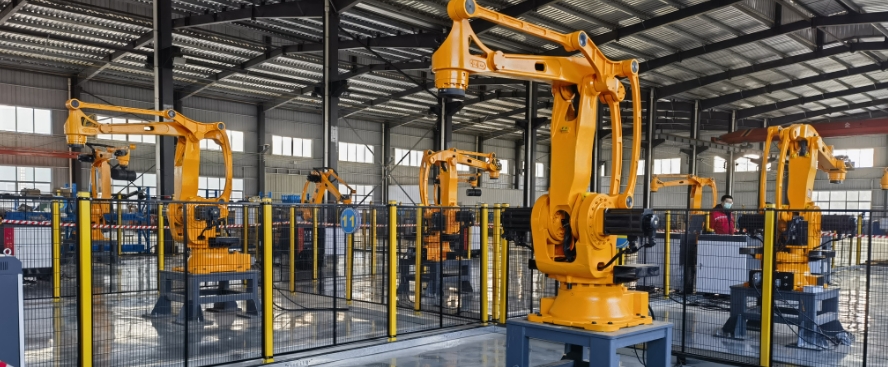
Automatic palletizing robot, a mechanical hand that never stops! So it's that simple!
Release Date:2024.02.28 Page Views:40156What is an automatic palletizing robot?
With the development of technology and the shortage of labor, many factories and workshops have chosen unmanned fully automatic palletizing robots for fully automatic palletizing in the palletizing process. This not only saves costs but also improves production efficiency. Industrial robot
The fully automatic palletizing machine robot is usually placed at the end of the production line, palletizing bagged, boxed, barreled and other materials from the production line onto the pallet according to the preset instructions.
01 Working Principle
The workpiece on the flat plate is a layer of workpiece that meets the requirements of the pallet. The flat plate and the workpiece move forward until they reach the vertical plane of the pallet. The upper stopper bar descends, and the other three positioning stoppers start to clamp. At this point, the plate returns to its original position. Each workpiece descends to the pallet plane. The distance between the pallet plane and the bottom surface of the flat plate is 10mm, and the pallet descends by one workpiece height. Repeat the above process until the pallet stacking meets the set requirements. The palletizing robot is equipped with a specially customized multi-functional gripper. Regardless of the size or weight of the packaging box, the robot can firmly hold and convey the packaging box using vacuum suction cups.
02 Strengths and Weaknesses
At present, the application of industrial robots is mainly concentrated in the automotive industry, the electronic and electrical industry, arc welding robots, spot welding robots, handling robots, etc. The following mainly discusses the palletizing robot among the handling robots. Palletizing robots are widely used in multiple industries, such as feed and fertilizer, grain, food, beverages, chemicals, building materials, and so on.
Its advantages are:
1. High productivity Enhance productivity by leveraging the performance, structure, and specialized tools for palletizing purposes. Fast and with a wide range of motion, it enhances production performance. The hollow structure is adopted to prevent cable failure of the gripper. The dedicated software for handling and palletizing can automatically generate palletizing programs, easily confirming the palletizing status, demonstrating the high productivity of the robot.
2. Wide range of mobility; The range of objects that can be moved is intermittently selectable from 3kg to 300kg, which is flexible and versatile, suitable for various objects and working environments that need to be moved, from small food items to large industries. Its applicability has been enhanced, liberating humans from heavy physical labor in all walks of life.
3. Simple maintenance; Fault diagnosis and improvement in structure, thereby reducing maintenance time and inspection time when faults occur, as well as component replacement time.
4. It occupies less space and has a large production capacity.
5. The whole machine is controlled by PLC and operates fully automatically.
6. Adaptable to various stack types and easy to adjust;
7. Multiple protections are available, and it can be controlled with a touch screen.
8. The conveyor chain is adopted for segmented transmission, and the output section can be extended arbitrarily.
9. The palletizing robot is programmable; It supports multi-degree-of-freedom movement, has flexible applications, and is simple, convenient and easy to operate.
Palletizing robots keep pace with The Times and have a broad industry prospect. However, this type of palletizing robot also has its shortcomings.
Its disadvantages are:
1. High cost; The cost of robots ranges from tens of thousands to millions of yuan for small models. Domestic ones are relatively cheaper, while imported ones deter many enterprises that want to replace human workers with robots.
2. Reliability and stability need to be improved; Compared with the complexity of operations such as welding and assembly, palletizing machines only need to complete relatively simple tasks like grasping and stacking. Therefore, their reliability and stability are lower than those of other types of robots.
3. Limited degree of intelligence; It is required to be able to work for a long time, with a low failure rate, and adapt to the changes in packaging environment and parameters of the operation objects. Moreover, the rapid growth in production speed demands that the equipment operate at high speed, which in turn requires the installation of advanced automatic control devices and supporting facilities to ensure the smooth operation of the robot, as well as the safety of the operators and the operation objects. Therefore, it is required that the robot itself has intelligent functions such as monitoring, detection, warning, diagnosis and repair.
4. Adaptability needs to be improved; Modern industrial production is characterized by small batch sizes, multiple varieties, frequent updates and replacements, and detailed division of labor. Palletizing robots have to deal with situations such as one machine for multiple products, multiple pallets, and multiple lines. The size parameters of the product (or package) and the palletizing mode are pre-programmed and input, and the robot itself cannot recognize the objects.
5. Intelligence The use of palletizing machines demonstrates the advantages of industrial robots: they are hardworking and reliable, ensuring both quality and quantity, and are excellent "workers". However, their drawback is that they require pre-programming and cannot independently understand and plan tasks.
6. Shortage of talents; Due to the complexity of robot structure control, employees using industrial robots need professional training. Even a simple action can lead to an accident if not handled properly. In contrast, for some simple processes, it would be much more convenient to complete them manually.
03 Production Line
The industrial robot palletizing production line is a highly integrated project, and there are also many devices in this project, including:
Conveying unit
2. Folded edge unit
3. Sealing unit
4. Inverting and pressing unit
5. Metal detection unit
6. Weight detection unit
7. Inkjet printing unit
8. Industrial robot palletizing unit