The automatic weighing and packaging machine measures food
Release Date:2023.03.11 Page Views:47931Although there has been development in the technical aspect of small-weighing quantitative packaging machines in our country, due to the common problems such as poor equipment, low technical strength, lack of assets and professional technical personnel, the product quality is unstable, the stability is poor, the features are outdated and single, and the upgrading time is long. Therefore, it lacks competitiveness in the global market.
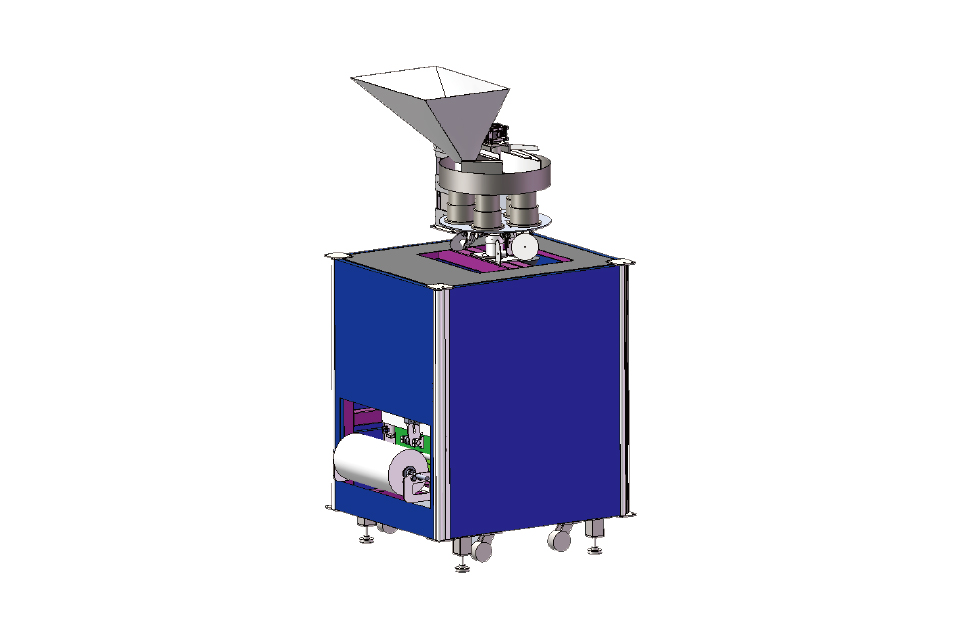
At present, small weighing quantitative packaging machines account for the vast majority in China. The quantitative part mainly uses volumetric methods such as beakers, extruders, screws or cylindrical screens. The packaging machines for making packaging bags are basically all general-purpose column-type packaging machines. This type of volume method uses a rotary cup filling method, which is distributed according to the percentage value. The material is cut based on the volume proportion inspected by the optical eye.
There are relatively few manufacturers of heavy-duty weighing and quantitative packaging machines. In most manufacturers, the quantitative part adopts the weighing method. Its advantage lies in the wide quantitative range, extensive coverage and high accuracy of the single-machine version. However, due to the limitation of the recovery time of important force transmission components such as sensors, the quantitative speed of the double-head version is unlikely to be too fast. To achieve a higher speed of operation, it is usually necessary to increase the number, which inevitably leads to an increase in cost.
In order to better handle the above difficulties, it is stipulated that the small weighing quantitative packaging machine adopts an electromagnetic induction feeder for feeding, and the resistance force type weighing sensor is used as the weighing force transmission component. This will be particularly suitable for powdery, micro-particle and granular raw materials. Or it can be carried out by using the microcomputer system software for sequential and synchronous metrological verification, and automatically select the better measured value that is close to or slightly larger than the calibration value as the output quantity of the raw material. It can achieve rapid weighing and packaging, and is suitable for quantitative weighing of various granular, small block, strip-shaped, block-shaped, spherical and irregularly shaped raw materials.
The difference lies in the characteristics of food. Only by adopting the corresponding metrological verification methods can the most accurate metrological verification be achieved. When packaging requirements are clearly put forward, the characteristics and appearance of the chemical substances to be packaged should also be clearly stated as much as possible, so as to obtain a sound packaging plan.